Send returns to
Darussalam Publishers UAE — Returns Department
Maysloon, Sheikh Zayed Street, Sharjah, UAE
Begin your journey of beneficial knowledge — explore our authentic Islamic library.
Explore Collection →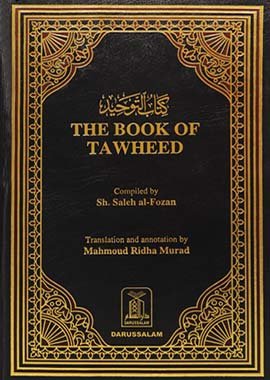
Publisher: Darussalam
Tax included. Shipping calculated at checkout.
Notify me when available
We'll email you the moment this is back in stock.
Frequently Bought Together
The Book of Tawheed (كتاب التوحيد, Kitab at-Tawheed) by Shaykh Saleh al-Fozan is a clear English guide to Islamic monotheism: what Tawheed is, what destroys or weakens it, what a Muslim must believe about the Prophet ﷺ and his Companions, and how to recognise innovation in religion. This Darussalam edition was translated and annotated by Mahmoud Ridha Murad. It is a 159-page hardcover in four sections, priced at 25 AED and dispatched from Sharjah.
Also searched as: Kitab at Tawheed English, Kitab al-Tawhid Fawzan, Book of Tawheed Saleh al-Fawzan, Tawheed book in English, Oneness of Allah book, Islamic monotheism book.
Official Darussalam edition · Translated and annotated by Mahmoud Ridha Murad · Free UAE delivery on orders over 300 AED
Title: The Book of Tawheed (Kitab at-Tawheed)
Author: Shaykh Saleh ibn Fawzan al-Fozan
Translation and annotation: Mahmoud Ridha Murad
Publisher: Darussalam
Language: English, with Qur'anic verses in Arabic
Pages: 159
Size: 14x21 cm
Binding: Hardcover
ISBN: 9789960892825
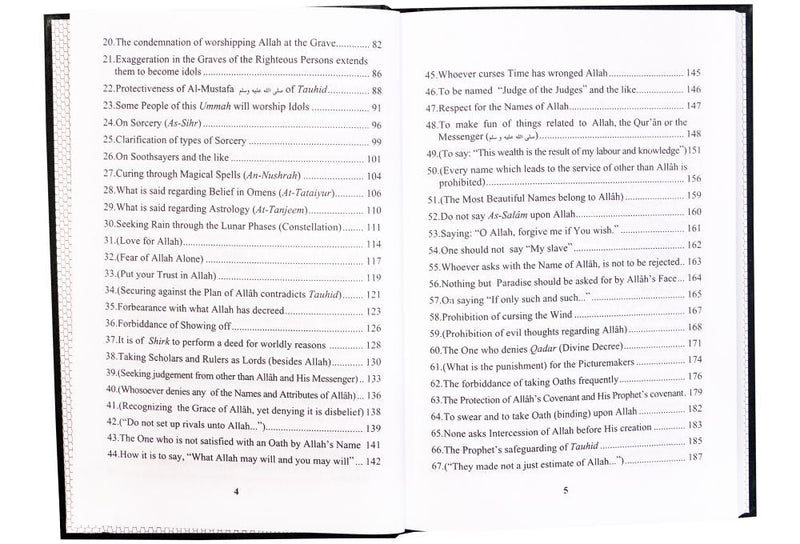
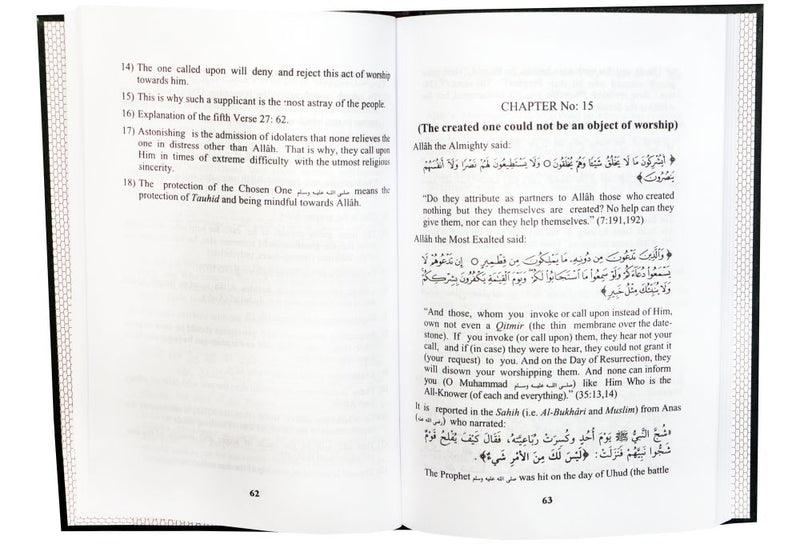
Allah created mankind to worship Him alone, and every act of worship depends on a sound belief in His Oneness. Shaykh al-Fozan's Book of Tawheed explains that belief in plain terms. Instead of treating Tawheed only as a theory, it shows what contradicts it in everyday life: superstitions, practices at graves and shrines, fortune-telling, amulets, swearing by other than Allah, and modern ideas such as materialism. Each chapter begins with the relevant verses of the Qur'an, given in Arabic with their English meaning, followed by hadith and a short, direct explanation. The translator's footnotes explain Arabic terms such as deen and Hanifan for readers who are new to them.
The book opens with how human beings drift away from the natural belief in Allah, then defines and explains the types of Shirk (polytheism), Kufr (disbelief) and Nifaq (hypocrisy). It closes the section with the related terms Jahiliyyah, Fisq, Dhalal and Riddah, so the reader understands exactly what each word means and how serious it is.
This is the most practical part of the book. Its chapters cover claiming knowledge of the unseen, including palm reading and cup reading; sorcery, kahanah (soothsaying) and 'irafah (fortune-telling); making offerings, vows and gifts at shrines; revering commemorative monuments; ruling by other than the laws of Allah; claiming the right of legislation; joining atheist sects; the materialist theory of life; charms and amulets; and swearing by other than Allah.
Tawheed includes giving the Messenger of Allah ﷺ his rightful place without going beyond it. This section explains the obligation to love him, to obey and follow him, what is legitimate in supplication, the merits of his household and of the Companions, and the prohibition of abusing the Companions.
The final section defines bid'ah, its kinds and rulings, explains why innovations spread, and sets out the position the Muslim Ummah should take towards them. It ends with examples of contemporary innovations, including celebrating the Prophet's ﷺ birthday, seeking blessings from places, and innovations in acts of worship.
Many readers searching for "Kitab at-Tawheed" are looking for the famous book by Shaykh Muhammad ibn Abdul Wahhab. This is a different work. Shaykh al-Fozan's Book of Tawheed is a shorter, modern explanation arranged in four sections, written in the same spirit and covering many of the same issues. It is an excellent first book before moving on to the classical text and its commentaries. If you want Ibn Abdul Wahhab's book with explanation, see Interpretation of Kitab at Tawheed or the Commentary on Kitab at Tawheed (2 volumes) in English, or Fath-ul-Majeed, the classical Arabic commentary.
Shaykh Saleh ibn Fawzan al-Fawzan is one of the senior scholars of Saudi Arabia, a member of the Council of Senior Scholars and of the Permanent Committee for Islamic Research and Fatwa. He has taught creed and fiqh for decades, and his books on 'aqeedah are studied in schools, universities and mosques around the world. His writing is known for being concise and firmly based on the Qur'an and Sunnah.
• New Muslims and young adults who want a short, reliable explanation of Tawheed in English.
• Students of 'aqeedah preparing to study Kitab at-Tawheed by Ibn Abdul Wahhab and its commentaries.
• Teachers and study circles looking for a clear four-part course on creed.
• Families who want to protect their homes from superstitions, amulets and innovations. For children, see My Tawheed Book.
Shaykh Saleh ibn Fawzan al-Fozan, a member of Saudi Arabia's Council of Senior Scholars.
It was translated and annotated by Mahmoud Ridha Murad and published by Darussalam.
No. It is a separate book by Shaykh al-Fozan on the same subject. For Ibn Abdul Wahhab's book with explanation, see Interpretation of Kitab at Tawheed, the Commentary on Kitab at Tawheed or Fath-ul-Majeed.
Four sections: Shirk, Kufr and Nifaq; statements and actions that negate Tawheed; beliefs about the Prophet ﷺ, his household and Companions; and bid'ah (innovations).
Yes. Section 2 has chapters on claiming knowledge of the unseen, sorcery, soothsaying and fortune-telling, and charms and amulets.
Yes. Section 4 defines bid'ah, explains why it spreads, and gives contemporary examples such as celebrating the Prophet's ﷺ birthday and seeking blessings from places.
Yes. The chapters are short, start with Qur'anic verses and hadith, and the translator's footnotes explain Arabic terms.
This Darussalam hardcover has 159 pages and measures 14x21 cm (ISBN 9789960892825).
It costs 25 AED on Darussalam UAE.
Yes. Orders are dispatched from Sharjah to all emirates, usually within 2–4 working days, and orders over 300 AED qualify for free delivery. Cash on delivery is available at checkout.
| Publisher | Darussalam UAE |
|---|---|
| ISBN / Barcode | 9789960892825 |
| SKU | e20035 |
Free delivery on orders over 300 AED. Standard delivery: 2–4 working days.
What readers say
No reviews yet. Read it? Be the first to share your thoughts with other readers.



Request a return within 15 days. We’ll review and respond within 24 hours.
Click Capture Image or drag the cursor to highlight a specific area